Blagaj · 7 min read
Blagaj Tekke — The 600-Year-Old Dervish House at the Buna Spring
Blagaj Tekija (Tekke) is a 600-year-old Sufi dervish house built into the cliff at the source of the Buna river. Ottoman period, still active. Hours, entry fee, photos, dress code, and how to get there from Mostar.
Quick answer
Blagaj Tekija (Tekke) is a 600-year-old Sufi dervish house built into the cliff at the source of the Buna river. Ottoman period, still active. Hours, entry fee, photos, dress code, and how to get there from Mostar.
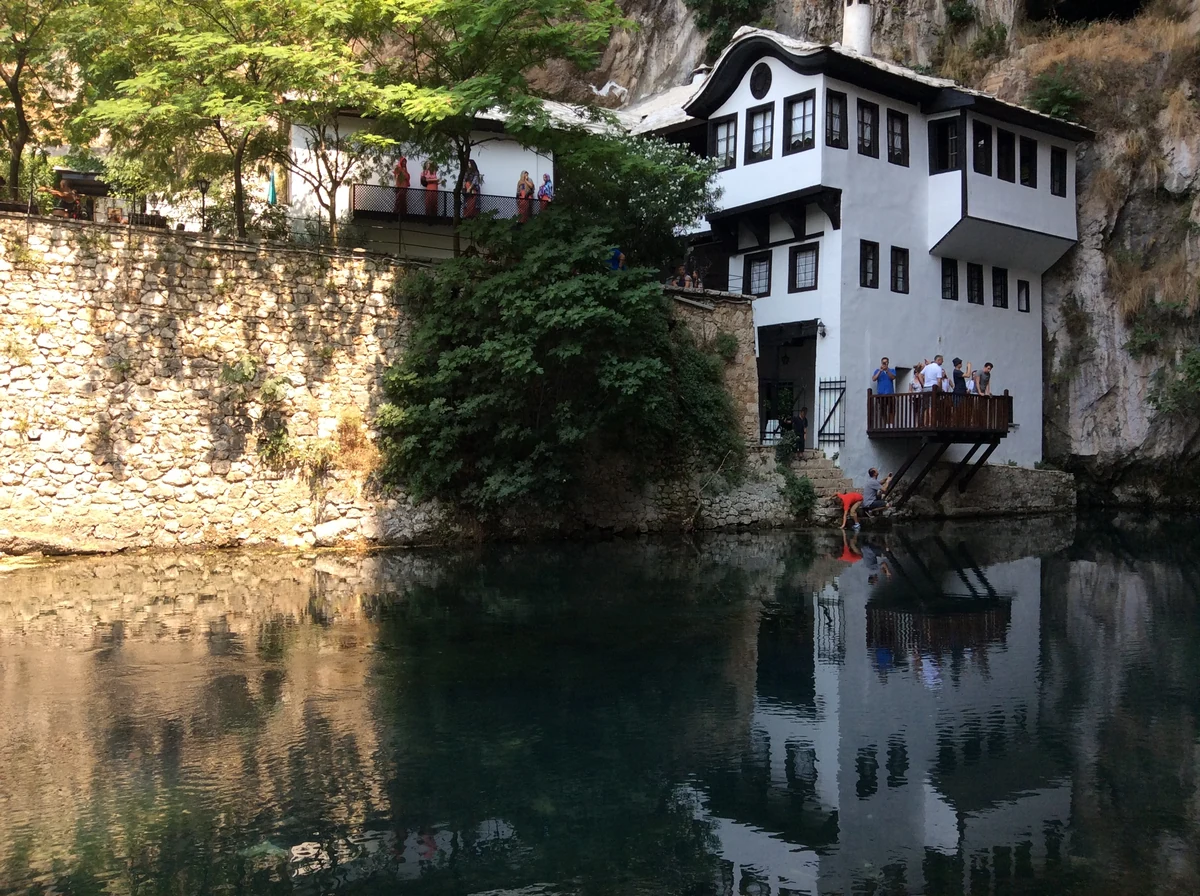
Blagaj Tekke is the most photographed landmark in Herzegovina after Stari Most — a small white Ottoman-era Sufi monastery built into a 200-meter limestone cliff at the source of the Buna river, 12 km southeast of Mostar.
It is not the same as Blagaj Fortress. The Tekke is at the bottom of the cliff, dates from the early 1500s, and is religious. The Fortress is on the hilltop above the village, dates from the early 1200s, and was a Bosnian royal seat. Two entirely different periods, two entirely different sites — most travelers only see the Tekke and don’t realise the fortress is up there.
What it is
Built around 1520 during the early Ottoman period, the Tekke (Bosnian: tekija) is a Sufi lodge that housed traveling dervishes — Islamic mystics belonging to the Bektashi and later the Halveti orders. The site combines a wooden two-storey monastery building, an open river-facing veranda, an inner prayer room (semahane) where dervishes performed their meditation rituals, and a small mausoleum (türbe) containing the sarcophagi of two saints — Sari Saltik and Açık Baş.
The architecture is unusual for two reasons: it’s built directly against the cliff (not just near it — the cliff forms the back wall of the courtyard), and it sits at the immediate source of the Buna spring, one of the largest karst springs in Europe (~43,000 litres per second, year-round, 7–9 °C).
Why dervishes built here
Sufi orders chose places of natural mystical significance. The combination of a cliff face, a cave (the Buna emerges from a deep underwater cave system), and a powerful river spring is exactly the kind of dramatic sacred geography Sufism prized. The Halveti order used solitary cave retreats for 40-day prayer cycles; the small caves in the cliff above the Tekke were used for exactly this purpose.
The Tekke remained continuously active through five centuries — Ottoman, Austro-Hungarian, Yugoslav (under restrictions), independent Bosnia. It was last fully restored in 2012 with funds from the Aga Khan Trust for Culture.
What to see
- The semahane — the inner ritual room, with low cushioned benches, a wooden mihrab marking the direction of Mecca, and an ornate ceiling.
- The türbe — separate small room holding the sarcophagi of the two saints; women keep heads covered here.
- The river veranda — wooden platform extending out over the Buna, used for gatherings; best photo angle of the cliff face.
- The cave at water level — a short walk to where the spring actually emerges; in spring, the volume of water makes the ground vibrate.
- The riverside restaurants — three of them, all serving Bosnian trout (pastrmka) caught in the Buna upstream. Reasonable prices (€10–18 per main).
Practical info
| Entry | €5 / 10 KM, cash at the gate |
| Hours | 8:00–22:00 (Apr–Oct) · 9:00–17:00 (Nov–Mar) |
| Dress code | Shoulders + knees covered. Free wraps at entrance if needed. |
| Time needed | 45 minutes minimum, 2 hours with lunch and swim |
| Photography | Allowed inside and outside |
| Wheelchair | The path from parking is paved but the Tekke itself has stairs — partly accessible only |
| Parking | Free, 200 m before the Tekke |
How to combine with other stops
- Blagaj Fortress — 30-min walk uphill, very different period
- Bunski Kanali — small Buna canals 5 minutes from the Tekke, a quiet local picnic spot most tour groups miss; included in our Kravica day tour
- Pocitelj — 30 minutes south by car, Ottoman fortified village
- Kravica Waterfall — 45 minutes south, Bosnia’s largest waterfall
- Via Ferrata Blagaj (Vulin Potok) — guided 500 m iron-path climb along the Buna canyon wall, paired with a Tekke visit on the descent, €60 / person
For a day combining all four, our Kravica day tour from Mostar is built exactly around this route.
FAQ
Frequently asked questions
What is Blagaj Tekke?
A Sufi dervish lodge (tekija / tekke) built around 1520 against a 200-meter cliff at the source of the Buna river, 12 km southeast of Mostar. Ottoman-period Islamic monastic architecture — used by the Bektashi and later Halveti dervish orders for prayer, study, and gathering. Still functioning as a religious site today, alongside its role as one of Bosnia's most photographed landmarks.
Is Blagaj Tekke the same as Blagaj Fortress?
No — two entirely different sites in the same village. **Blagaj Tekke** sits at the bottom of the cliff, at the river spring, and is from the Ottoman period (~1520). **[Blagaj Fortress](/blagaj-fortress/)** (Stjepan-grad) sits on the hilltop above the village and is medieval — built in the early 13th century by the Bosnian kings. About 30 minutes' walk separates them. Worth seeing both if you have a half day.
What's the entry fee and opening hours?
**€5 per person** (10 KM), paid at the small ticket booth before the bridge. **Open daily 8:00–22:00 in summer, 9:00–17:00 in winter.** Free for children under 7. Cash only — no card payment at the gate.
Is there a dress code?
Yes. As an active religious site, modest dress is required: shoulders covered, knees covered. Long skirts or trousers are required for women — wraps are provided free at the entrance if you arrive in shorts. Shoes off when entering the inner prayer rooms (a small shoe shelf is provided).
How long do I need at the Tekke?
**45 minutes is enough** for the standard visit — the inner prayer rooms, the divan with the sarcophagus of the dervish saints (Sari Saltik and Açık Baş), the river-facing veranda, and the cliff base. Add 30 minutes if you want to swim in the icy spring water (allowed in the small river just outside the Tekke), and another 30 if you eat lunch at one of the riverside restaurants.
Can I swim in the Buna river?
Yes — locals swim in the small Buna river right outside the Tekke. The water is **7–9°C year-round** because it comes straight from underground karst caves. Five seconds is bracing, thirty seconds is genuinely painful. Most travelers just dip a hand in. Bring a towel if you want to actually swim.
How do I get to Blagaj from Mostar?
**By car:** 15 minutes south on regional road R-435 to Buna, then left at the sign for Blagaj. Free parking 200 m before the Tekke. **By bus:** local bus #11 from Mostar bus station, ~30 minutes, €2 each way, runs every 30 minutes 6 AM – 10 PM. **By tour:** all our [Kravica day tours from Mostar](/kravica-waterfall-tour-from-mostar/) include a 45-minute stop at the Tekke.
Best time of day for photos?
**Late afternoon (4–6 PM)** — the cliff face turns golden in the western light, and the Tekke's white walls glow. Avoid midday: the Tekke sits in deep cliff shadow until ~11 AM, then bright contrast 11–3, then golden hour from 4. Spring (April–May) for the highest water flow, autumn (September–October) for the best colour against the green river.