Planning · 14 min read
Mostar Travel Guide 2026 — A Local's First-Time Visitor Handbook
Everything a first-time visitor needs to know about Mostar — from the bridge jumpers to the best burek, the war history, and what to skip.
Quick answer
Everything a first-time visitor needs to know about Mostar — from the bridge jumpers to the best burek, the war history, and what to skip.
Quick answer: Mostar is a half-day Old Town visit, but two days and one night is the sweet spot — that gives you the city plus one regional day-trip (Kravica Waterfall, Blagaj, or Počitelj). Best months are May–June or September–early October. Expect to spend €70–110/day on a mid-range trip in 2026. Stay within 5–10 minutes’ walk of Stari Most. Bring some KM cash for counter spots; cards work everywhere else. The city is safe, the tap water is drinkable, and the bridge dive is the real thing.
This guide is written by a Mostar-resident guide. It covers what every first-time visitor should know before arriving and the eight mistakes that most travellers make on their first trip — at the end.
How long to spend in Mostar
The right answer depends on what else you’re doing in the region.
| Time available | What it gets you | Best for |
|---|---|---|
| Half day (4 hours) | Stari Most, Old Bazaar walk, one quick coffee or burek | Cruise stop, transit-day stop |
| One full day | Old Town + one minor stop (Crooked Bridge, Koski mosque minaret), one sit-down meal | Day-trippers from Dubrovnik / Split — but you’ll miss the evening |
| 2 days / 1 night ✅ recommended | Full Old Town + Stari Most after dark (best part) + one regional day-trip (Kravica, Blagaj, or Počitelj) | Most first-time visitors |
| 3 days / 2 nights | Full city + Kravica + Blagaj + Počitelj + a slower morning | Anyone who wants the full Herzegovina cluster |
| 4+ days | Above + an outlying day-trip (Sutjeska National Park, Konjic, Sarajevo) | Mostar as your Bosnia base |
The key insight: Mostar’s best hours are after the day-trippers leave (after 18:00) and before they arrive (before 09:30). If you only do a single day from a Croatian coast city, you experience the city at its busiest and miss the half that makes it worth coming for.
For full day-by-day plans see our Mostar 1-2-3 day itinerary guide.
When to visit — month-by-month
| Month | Daytime high | Crowd level | Notes |
|---|---|---|---|
| Jan–Feb | 8–12°C | Lowest | Quiet, atmospheric, occasional snow on the bridge. Some restaurants closed. |
| Mar | 13–17°C | Low | Spring rains; everything reopens mid-month. |
| Apr | 17–21°C | Low–medium | Shoulder season. Cheaper, quieter, weather hit-or-miss. |
| May ✅ | 22–26°C | Medium | Best balance. Warm enough for evenings out, cool enough for hiking. |
| Jun ✅ | 27–31°C | Medium–high | Swimming at Kravica becomes pleasant. Long daylight. |
| Jul–Aug | 33–42°C | Highest | Heatwaves common; plan outdoor stuff before 11:00 or after 17:00. Book accommodation 2 months ahead. |
| Sep ✅ | 26–30°C | Medium–high (early) → low (late) | Peak month for the right balance after Aug. Kravica swimmable until ~20 Sep. |
| Oct | 18–24°C | Low–medium | Beautiful light, quiet. Kravica scenic only after mid-Oct. |
| Nov–Dec | 8–14°C | Lowest | Old Town atmospheric in fog/rain. Some restaurants take winter break. |
Best windows: 1 May – 25 June, and 5 September – 15 October. Outside those, expect tradeoffs.
How to get to Mostar
| Origin | Bus | Train | Private transfer | Self-drive |
|---|---|---|---|---|
| Sarajevo | 2.5h, €12–18, hourly | 2h, €10–12 ✅ | 2h, €110–140 | 2h via M17 |
| Dubrovnik | 3.5–4h, €18–25, 4–6/day | — | 2.5h, €130–170 | 3h (passport: M-B-M-B border) |
| Split | 3.5h, €20–28, 3–4/day | — | 3h, €170–220 | 3h |
| Belgrade | 8–10h overnight, €30–40 | — | 7h, €350+ | 7–8h |
| Zagreb | 8–10h, €30–40 | — | 7h, €380+ | 7h |
The Sarajevo train is the standout — it runs through the Neretva canyon and is one of the most scenic short rail rides in the Balkans. See our full Sarajevo–Mostar guide for the timetable, comparison, and which option suits which traveller.
For private transfers from any city to Mostar — private transfers from €60 for short routes, English driver, fixed price, no airport drop-off surprises.
Where to stay in Mostar
| Zone | Walk to Stari Most | Vibe | Price (mid-range, peak) |
|---|---|---|---|
| Old Bazaar quarter (east) ✅ | 0–3 min | Ottoman atmosphere, foot-traffic, dawn/dusk magic | €60–110/night |
| Brankovac / under-Fortica (east) | 5–10 min | Quieter, residential, 5 min walk to bridge | €50–85/night |
| West Mostar (across Bulevar) | 12–20 min | Modern, easier parking, more chain hotels | €55–95/night |
| Highway strip / outskirts | 20+ min by car | Cheaper, soulless, you’ll commute for everything | €35–60/night |
| Blagaj or Počitelj | 25 min by car | Village atmosphere, dramatic settings | €50–90/night |
Recommendation for first-timers: book in the Old Bazaar quarter or 5–10 min east. The Old Town atmosphere after the day crowds leave is the single best part of being in Mostar — staying anywhere else means you commute back to it and miss the off-hours window.
Book 6–8 weeks ahead for July–August. Outside peak, 2–7 days ahead is usually fine.
What to see — the top 7
1. Stari Most (the Old Bridge)
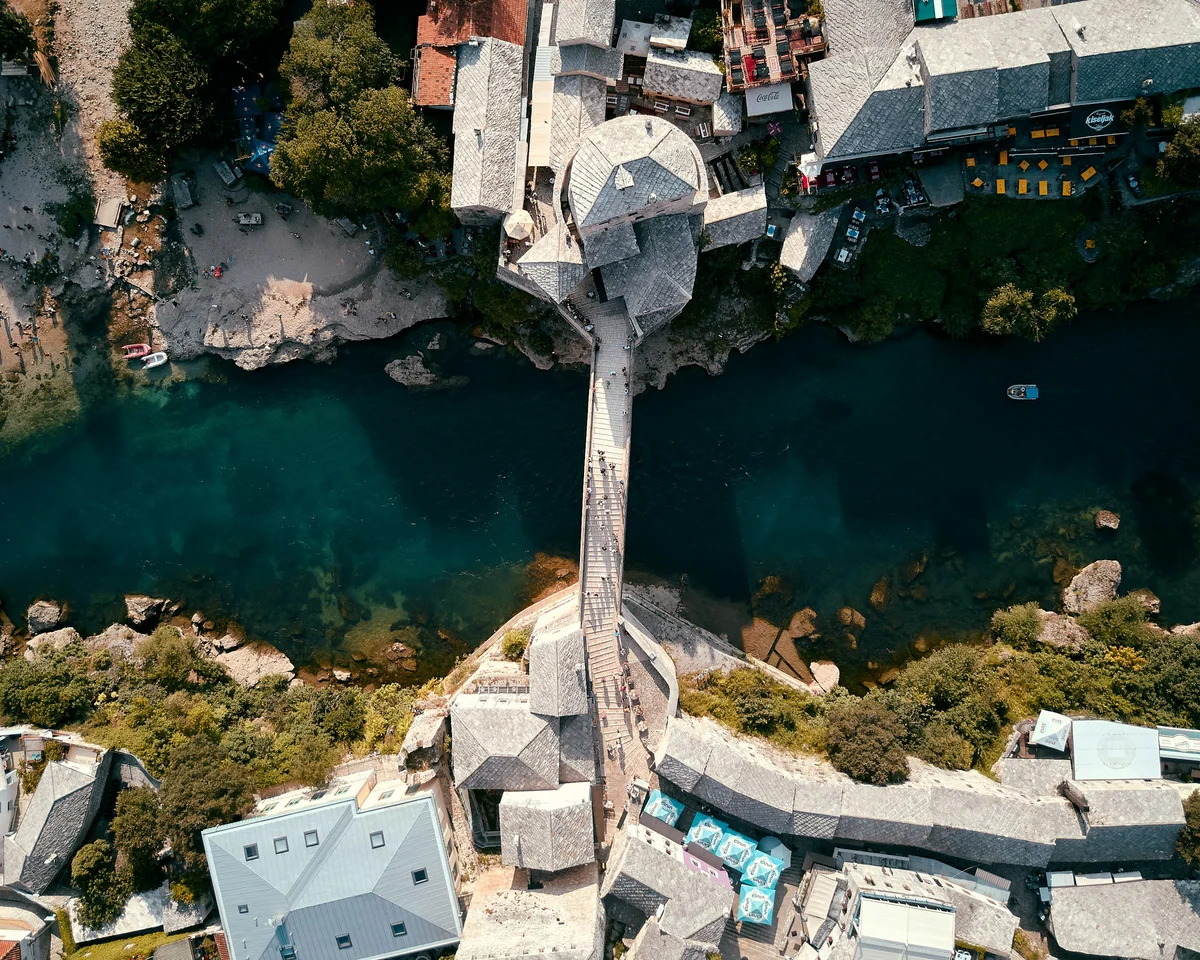
The 16th-century Ottoman bridge that gives the city its name (it was rebuilt 2004 after destruction in 1993). UNESCO World Heritage site. Walk it twice — once in daylight, once at night, when it’s lit and crowd-free. Watch for the bridge divers (red Speedos, tip €20–30 collected before each jump — see Mostar bridge diving guide).
2. Old Bazaar (Kujundžiluk)
The cobblestone copper-and-craft market street running east from the bridge. Real coppersmiths still working (look for the small open workshops). Best photo light is morning; best browsing is evening when the heat eases.
3. Koski Mehmed-Pasha Mosque
For the best aerial view of Stari Most, climb the minaret (4 KM / €2 entry). Narrow, claustrophobic stairs — not for anyone with mobility limits or claustrophobia. The view is the postcard shot.
4. Crooked Bridge (Kriva Ćuprija)
A miniature version of Stari Most, 5 minutes upstream on the Radobolja stream. Built 1558, predates Stari Most. Free, much less crowded, equally photogenic. Most day-trippers miss it.
5. Fortica Sky Walk
The 35-metre glass platform 500m above the Old Town, reached by car or shuttle. Free entry. Best aerial view of the bridge and the Neretva valley. See our Fortica Sky Walk guide for shuttle options and how to combine with the zipline.
6. Blagaj Tekija (the Dervish House)
A 600-year-old Sufi monastery built into a 200-metre cliff at the source of the Buna spring. 25 minutes by car/taxi from Mostar. €5 interior entry, optional. Most people stay 45–60 minutes. See our Blagaj Tekke guide.
7. Kravica Waterfall
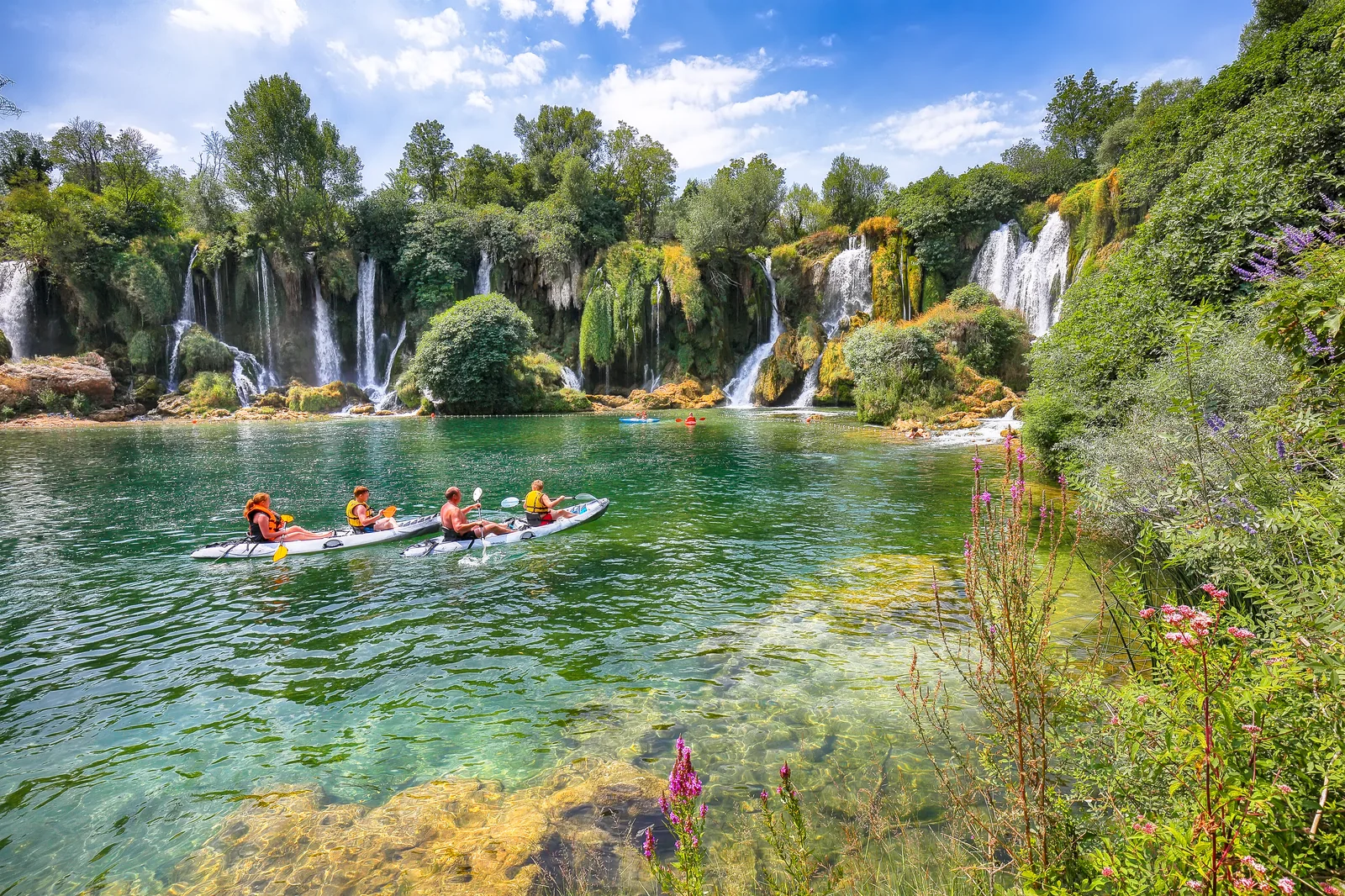
Bosnia’s largest waterfall (25 m tall, 100 m wide travertine cliff). 40 minutes south of Mostar. €10 entry. Swimmable June–September. See our Kravica Waterfall pillar guide for transport, season, and what to bring.
For the full 20-stop list see our Things to do in Mostar city pillar.
Money, costs & how to pay
Currency: Convertible Mark (KM / BAM). Pegged at 1 EUR = 1.95 KM (effectively 2:1 in tourist transactions).
Cards work at hotels, sit-down restaurants, supermarkets, and most museums. Cash is needed for ćevabdžinicas, market stalls, small shops, taxis, some attractions.
ATMs are everywhere. Skip the dynamic currency conversion (“would you like to be charged in EUR?”) — you lose 5–7% every time. Always choose the local currency (KM).
Bring some euros — accepted in tourist-area places at 1:2 rate. Don’t rely on euros for non-tourist transactions.
Tipping — 10% generous at sit-down restaurants, rounding up standard for casual meals. Cash tips preferred. See our Best restaurants in Mostar for tipping details and which spots are card vs cash.
Daily cost (mid-2026 prices):
- Backpacker: €35–50/day
- Mid-range ✅: €70–110/day
- Comfort: €130–200/day
For the full breakdown see our Mostar budget guide.
Practical: tap water, language, plugs, etiquette
- Tap water: drinkable. Free carafes in restaurants if you ask. See Mostar tap water guide.
- Language: Bosnian. English widely understood in tourist areas. German common with older generation.
- Electrical plugs: Type F (Schuko, two round pins). Same as Germany / France / most of Europe. UK and US visitors need an adapter.
- Mosque etiquette: remove shoes, women cover hair (carry a light scarf), shoulders and knees covered, quiet during prayer. Some mosques charge a small entry (€2–5) and have sign-posted rules.
- Photography: free in public space. Ask before close-ups of people, especially elderly locals. Don’t photograph inside mosques during prayer.
- Greetings: Dobar dan (good day), Hvala (thank you), Molim (please / you’re welcome), Doviđenja (goodbye).
Safety in Mostar
Mostar is one of the safest cities in Europe for tourists. Violent crime is rare, locals are warm to visitors, and police presence in the Old Town is visible.
Practical precautions:
- Petty pickpocketing is rare but possible in the densest Old Bazaar choke points — keep your phone in front pockets.
- Don’t leave bags or visible valuables in parked cars (true everywhere).
- Use marked taxi companies or hotel-arranged cars at night, not flagged ones.
- Drive strictly to speed limits — speed traps are real and tickets are issued on the spot.
Landmines — yes they exist in Bosnia, no they’re not on any tourist path. The risk is confined to remote, unmarked rural backcountry far from any road, hiking trail, or village you’d visit. Stick to marked surfaces (every road, every trail, every village) and you have nothing to worry about. Don’t ever step into unmarked fields or off-piste rural areas.
Emergency numbers: 122 police, 124 ambulance, 123 fire.
For solo female travellers see our dedicated Solo Female Travel in Mostar guide.
What to pack
The non-obvious essentials:
- Comfortable shoes with grip — the bridge and Old Bazaar are polished cobblestone, ice-slick when wet. Flat sandals are the most-regretted footwear of every season.
- Light scarf (women) for mosque visits.
- Reusable water bottle — tap water is drinkable, fountains in some squares.
- Cash mix — €100–200 worth of KM in small notes for counter-style spots.
- Layers for May/Sep evenings — daytime warm, evenings cool to chilly.
- Swimwear + water shoes if visiting Kravica or Buna pools (rocky bottoms).
- Universal Type F plug adapter for non-European electronics.
- Lightweight rain layer Apr–Jun and Sep–Nov.
Mostar mistakes to avoid
The most common things first-time visitors get wrong:
- Day-tripping from Dubrovnik or Split and skipping the night. You’ll see Mostar at its most crowded and miss its quietest, most beautiful hours after 18:00 and before 10:00.
- Picking restaurants by who has touts outside, not by reviews. The Old Bazaar has both excellent kitchens and tourist traps within 30 metres of each other — see our Best restaurants in Mostar for 12 picks verified on TripAdvisor.
- Visiting Kravica Nov–Mar expecting to swim. The café closes off-season, the water drops to 10–12°C, and the whole site feels half-dormant. Beautiful for photos, not for swimming.
- Wearing flat sandals on the bridge. It’s polished marble-cobble, slippery wet or dry. Real shoes with grip.
- Driving into the Old Town. Pedestrian zone, no parking. Use one of the perimeter lots (Bulevar side) and walk 5–10 minutes.
- Skipping Blagaj or Počitelj. Both 25–30 min away, both worth a half-day each. Easy to combine with Kravica in a single day-tour.
- Not having any KM cash. Counter-style ćevabdžinicas, market stalls, cheap museums and some entries are cash-only.
- Booking a 6-hour Mostar day-tour from Dubrovnik. 4 of those hours are bus. Either come for a night or skip Mostar — a rushed visit is the worst version of a great place.
Suggested first-timer day plan
A quick template for your first 24 hours:
- Day 1, 14:00 — arrive, drop bags, walk to Stari Most for first impression
- Day 1, 16:00 — Crooked Bridge + Koski mosque minaret view
- Day 1, 19:00 — early dinner at Šadrvan or Hindin Han (book ahead in peak)
- Day 1, 21:30 — return to bridge for night photography (lit, crowd-free)
- Day 2, 08:00 — burek breakfast at Buregdžinica Rodjeni
- Day 2, 09:30 — full-day Kravica + Blagaj + Počitelj tour (or DIY)
- Day 2, 18:00 — Bosnian coffee at Cafe de Alma
- Day 2, 20:00 — dinner + onward travel or second night
For full 2-day and 3-day itineraries see Mostar in 1, 2 or 3 days.
Visit on a guided tour
Our Kravica Waterfall day tour from Mostar combines Kravica, Počitelj, Blagaj, Bunski Kanali, and the Fortica Sky Walk in one full day. €50 per person, hotel pickup, English-speaking guide, max 8 guests.
For multi-stop custom trips with full flexibility, private transfers from Mostar start at €60/vehicle for short routes. WhatsApp +387 62 694 887.
Related guides
- Things to do in Mostar — full 20-stop city pillar
- Mostar 1-2-3 day itinerary — day-by-day plans
- Best restaurants in Mostar — 12 local picks
- Kravica Waterfall pillar guide — the day-trip you’ll do
- How to get from Sarajevo to Mostar — train, bus, private transfer
- Mostar tap water — yes, it’s safe
- Solo female travel in Mostar — practical safety
- Mostar in winter — different city Dec–Feb
- Mostar budget guide — full cost breakdown
FAQ
Frequently asked questions
How many days do you really need in Mostar?
**Two days and one night is the sweet spot.** A single day is enough to see the Old Bridge, walk the Old Bazaar, and have one good Bosnian meal — but you'll miss the city after the day-trippers leave (which is when Mostar becomes Mostar). Two days lets you cover the city plus one regional day-trip (Kravica, Blagaj, or Počitelj). Three days lets you do the full Herzegovina cluster — Kravica, Blagaj, Počitelj, plus a slower wander through the city. Four+ days only makes sense if you're using Mostar as a base to explore further (Sarajevo, Sutjeska, the Adriatic coast).
When is the best time to visit Mostar?
**May–June and September–early October** are the sweet spots — daytime temps 22–28°C, evenings cool, swimming at Kravica still works (June and Sept), all attractions open, and crowd levels manageable. **July–August** is peak heat (38–42°C heatwaves common) and peak crowds — book accommodation 2 months ahead, plan outdoor activities for early morning or after 17:00. **November–March** is the quiet season — Old Town atmospheric, prices 30–40% lower, but Kravica is closed-feel (no swimming, café closed Nov–Mar) and rain is common. **April and late October** are shoulder months — cheaper, quieter, but weather is hit-or-miss.
Is Mostar safe for tourists in 2026?
**Very safe.** Bosnia has lower violent crime than most of Western Europe and Mostar is one of the safest cities in the country. Solo female travelers report no harassment issues — see our [Solo Female Travel guide](/solo-female-travel-mostar-safety/) for specifics. Standard precautions apply: don't leave valuables in parked cars, watch your phone in the busiest Old Bazaar choke points, use official taxis or hotel-arranged transport at night. Landmines from the 1992–95 war exist only in remote, unmarked rural backcountry — never on any tourist path, road, or trail you'd walk. Stick to marked surfaces and you have nothing to worry about.
What's the currency in Mostar and should I bring euros?
Bosnia uses the **Convertible Mark (KM or BAM)**, pegged at **1 EUR = 1.95 KM**. Bring some euros — they're widely accepted in tourist-area restaurants and shops, usually at a 1:2 rate (slightly worse than official). For supermarkets, taxis, market stalls, and most non-tourist transactions you need KM. **Cards work** at sit-down restaurants, hotels, and supermarkets; cash is needed for ćevabdžinicas, market stalls, small shops, and some museum entries. ATMs are everywhere — withdraw KM (skip the dynamic-currency-conversion offer to charge in EUR; you always lose 5–7% on that).
Can I drink tap water in Mostar?
**Yes — Mostar tap water is safe and good quality**, sourced largely from mountain springs in Herzegovina. Restaurants will give you free carafes if you ask. Bottled water is widely sold (€0.80–1.50 per half-litre) but it's a convenience purchase, not a safety requirement. The same applies to Sarajevo and most of central Bosnia. See our [Mostar tap water guide](/mostar-tap-water-safe-drink-travel-guide/) for the technical details on sourcing and quality monitoring. If you're sensitive to mineral content changes (some travellers are), give it a day to adjust — but it's safe from drop one.
What language is spoken in Mostar?
Bosnian is the official language (Croatian and Serbian are essentially the same language with regional spelling and word differences — locals understand all three interchangeably). **English is widely spoken** in tourist-facing businesses — hotels, restaurants in the Old Bazaar, taxi dispatch, tour operators. German is common with the older generation (1970s–80s economic migration to Germany and Austria). A few learned phrases go a long way: *Dobar dan* (good day), *Hvala* (thank you), *Molim* (please / you're welcome). Outside the tourist core (supermarkets, pharmacies, public transport) basic English usually works but isn't guaranteed.
How do I get from Sarajevo, Dubrovnik, or Split to Mostar?
**From Sarajevo**: train (2h, €10–12, scenic Neretva canyon route), bus (2.5h, €12–18, more frequent), private transfer (2h, €110–140 / vehicle), self-drive (2h via M17). See our [Sarajevo to Mostar guide](/how-to-get-from-sarajevo-to-mostar/) for full options. **From Dubrovnik**: bus (3.5–4h, €18–25), private transfer (2.5h, €130–170 / vehicle), self-drive (3h via Neum corridor — bring your passport). **From Split**: bus (3.5h, €20–28), private transfer (3h, €170–220 / vehicle). All three city pairings are doable as day trips but tight — overnighting in Mostar is much better.
Where should I stay — Old Town or West Mostar?
**Stay in or within 5–10 min walk of the Old Town** for first-time visitors. The Old Bazaar quarter has the highest concentration of guesthouses, cafés, and the closest access to Stari Most for sunrise/evening photo windows when the day-trippers are gone — which is the best time to experience Mostar. West Mostar (across the Neretva, the postwar Croat-majority side) has more modern hotel options and easier parking but you'll be commuting 15–20 minutes back to the bridge area for everything you came to see. **Skip large highway-strip hotels** — they save €15–25/night but cost you the city. Book 6–8 weeks ahead for July–August; outside peak you can usually find something 1–2 days out.
What's the typical daily cost in Mostar?
**Backpacker**: €35–50/day (hostel dorm €15–20, ćevabdžinica meals €5–8, beer €2–3, free attractions). **Mid-range**: €70–110/day (boutique guesthouse €50–80, sit-down lunch + dinner €25–40, one paid attraction €5–10, drinks €10). **Comfort**: €130–200/day (4-star €100–140, fine-dining dinner €30–50, full-day private tour €100–250 split between group, drinks). Compare to Dubrovnik or Split where the same comfort tier runs €250–400/day — Mostar is the cheapest sit-down-meals city on the Adriatic corridor in 2026. Drinks add up fast at view-bars near the bridge (€5–7 cocktails) — eat a few minutes back from Stari Most for 30–40% lower bills.
Is the Old Bridge dive a real thing or just a tourist show?
Both. The dive is **real and tradition-deep** — Mostar boys have been jumping the 24-metre drop into the Neretva since the bridge was built in 1566, and the annual diving competition (late July) draws international cliff divers. Throughout the season, local divers in red Speedos collect tips on the bridge before each jump (€20–30 minimum collected before they go). It's not staged — these are trained divers, the water below is genuinely cold (10–14°C even in summer) and the technique is real. **Don't try it yourself** — the safe entry window is narrow, the water is colder than it looks, and tourists have been seriously injured attempting it. Watch, tip if you appreciated it, photograph from the side terraces (better angles than directly on the bridge).
What food should I prioritize in Mostar?
**Top 4 for first-timers**: ćevapi at Tima-Irma (€7–9 / portion of 5 or 10), burek with yogurt at Buregdžinica Rodjeni (€3–5 — eat at the counter), mixed grill at Šadrvan or Hindin Han (€12–18), and Bosnian coffee with rahat lokum at Cafe de Alma (€2.50). For the comprehensive list see our [Best Restaurants in Mostar](/best-restaurants-mostar/) — 12 verified picks with TripAdvisor ratings. Vegetarian/vegan: Food House Mostar and Timber & Stone Tavern are the two reliable options. Avoid the directly-on-the-bridge restaurants for full meals (30–40% pricier than equivalent food 5 minutes away) — sit there for sunset coffee instead.
What are the most common mistakes first-time visitors make?
(1) **Day-tripping from Dubrovnik or Split and skipping the night** — you'll see Mostar at its most crowded and miss its quietest, most beautiful hours. (2) **Eating directly under Stari Most** — view tax of €5–10 per dish, walk 5 minutes for better food at fairer prices. (3) **Visiting Kravica in November–March expecting to swim** — the café closes off-season and the water drops to 10–12°C; visit but plan it as scenery only. (4) **Wearing flat sandals** — the bridge and Old Bazaar streets are polished cobblestone that becomes ice when wet. (5) **Driving and parking in Old Town** — pedestrian zone, no parking; use one of the perimeter lots and walk. (6) **Skipping Blagaj or Počitelj** — both are 30 minutes away and worth the half-day each. (7) **Not having any KM cash** — counter-style ćevabdžinicas, market stalls, and some entries are cash-only. (8) **Booking a 6-hour day tour from Dubrovnik** — 4 of those hours are bus; either come for a night or skip Mostar.