Sarajevo attractions · 5 min read
Gazi Husrev-beg's Mosque: BiH's Largest Historical Mosque, First in the World With Electricity
Gazi Husrev-beg's Mosque in Sarajevo — built 1530–1532, 9 domes, 47m minaret, 1,500 worshippers. First mosque in the world to get electricity (1898). Free to visit.
Quick answer
Gazi Husrev-beg's Mosque in Sarajevo — built 1530–1532, 9 domes, 47m minaret, 1,500 worshippers. First mosque in the world to get electricity (1898). Free to visit.
Gazi Husrev-beg’s Mosque is the single most important historical building in Bosnia and Herzegovina — and one of the great Ottoman mosques anywhere. Free, open all day except prayer times, sits in the centre of Baščaršija.
The man and the year
Gazi Husrev-beg (1480–1541) was the Ottoman governor (sandžak-beg) of Bosnia. He ruled three times across two decades, fought in Hungary, raided Croatia, and built more public infrastructure in Sarajevo than any other Ottoman governor. The mosque, completed 1532, was the centerpiece of his vakuf — a charitable foundation that included a madrasa (Islamic school), library, hospice, marketplace, and bathhouse. The vakuf funded these institutions for 500 years; it still exists today as a foundation.
The architect
Acem Esir Ali (“Persian Captive Ali”) — the chief Ottoman court architect under Suleiman the Magnificent. Born in Tabriz (Iran), captured young, raised at the Ottoman court, became chief architect of the empire. Designed mosques across Anatolia and the Balkans before this one.
Some scholars argue Mimar Sinan — Esir Ali’s apprentice and the Ottoman empire’s greatest architect — also worked on it as a young man. Stylistic similarities to Sinan’s later domes support the theory but no document proves it.
What you see
The exterior: classic Ottoman style. Stone walls, lead-covered domes, single 47-meter minaret, a small portico with white marble columns. The shadirvan (ablution fountain) in the courtyard is octagonal, also from 1530s. Behind the mosque sit the founder’s türbe (tomb) and the slightly larger tomb of Murad-beg, his successor.
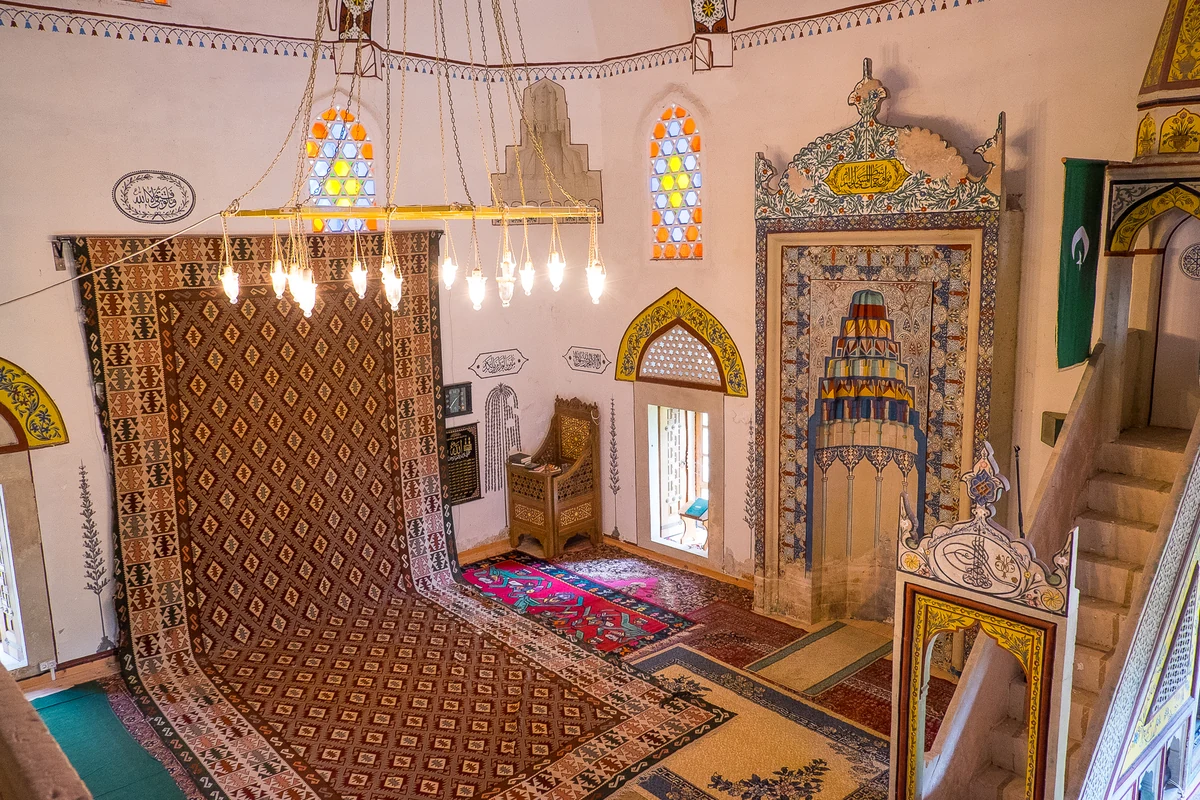
The interior: open, light, calmer than its scale suggests. The central dome rises 26 m. Walls covered in calligraphy and floral arabesques (re-painted 2001–2002 after war damage). The mihrab (prayer niche pointing toward Mecca) is white marble with carved muqarnas. Historic carpets cover the floor.
The tower clock (sahat-kula) next door is from 1697 and runs on lunar time — the only public clock in the world that does, set so that the hour-hand reads 12 at the moment of the evening (maghrib) prayer call. Adjusted ~6 minutes earlier or later every couple of weeks.
The 1898 electricity
Sarajevo got electric street lighting in 1895 — earlier than most Habsburg cities, far earlier than most of the Ottoman world. Three years later the mosque was wired up — the first mosque anywhere in the world to use electric light. The original lamp fittings (modified for modern bulbs) are still in place inside.
Visiting
Free entry. Outside the 5 daily prayer times (which last ~15 min each — schedule posted at entrance). Friday midday is busiest. Dress code strictly enforced: women cover hair (scarves available at door if needed) and shoulders; men long pants. Shoes off at the entrance — there’s a shelf.
Allow 20–30 minutes inside; another 10–15 for the courtyard and Husrev-beg’s tomb behind. Combine naturally with the Gazi Husrev-beg Library next door (oldest public library in BiH, 5,000+ Ottoman manuscripts, separate ticket).
How to get there from Mostar
- Mostar–Sarajevo private transfer — 2.5 hours, drops in Baščaršija at the door
- Sarajevo to Mostar day trip — guided round trip, includes interior visit
What to combine it with
- Baščaršija — surrounds the mosque
- Latin Bridge — 5 min walk south, where WWI started
- Sarajevo to Mostar day trip — full day with guide
FAQ
Frequently asked questions
Where is Gazi Husrev-beg's Mosque?
In the heart of Baščaršija, Sarajevo's old Ottoman bazaar. About 100 meters from the Sebilj fountain. Free entrance from Sarači street (the main bazaar artery). Coordinates: 43.8595° N, 18.4310° E.
When was it built?
1530–1532. Commissioned by **Gazi Husrev-beg**, the Ottoman governor (sandžak-beg) of Bosnia. Architect: **Acem Esir Ali**, the chief Ottoman court architect under Suleiman the Magnificent. Some scholars argue Mimar Sinan (his successor) may have been involved as a young apprentice.
What's special about it?
It's the **largest historical mosque in BiH** and one of the most important Ottoman buildings in the Balkans. Nine domes, a 47m minaret, capacity ~1,500 worshippers, with a complete **vakuf** (charitable foundation): library, madrasa school, marketplace, hammam (bath). Effectively the centre of Ottoman Sarajevo for 500 years.
Is it really the first electrified mosque in the world?
Yes — **the first mosque in the world to receive electric lighting, in 1898**, before any mosque in Istanbul, Cairo, or Damascus. Sarajevo got its city electric grid before most Habsburg cities; the mosque was an early adopter. Original light fittings still visible inside.
Can I visit as a non-Muslim?
Yes — open to visitors outside prayer times. **Dress code:** women cover hair and shoulders; men long pants. Shoes off at the entrance. Free; donations welcome. **5 daily prayer times** close it briefly to tourists. Friday midday (jumu'ah) is busiest — better come morning or afternoon.
What was damaged in the war?
Hit by Serb shells multiple times during the **Siege of Sarajevo (1992–95)**. The dome was holed, the minaret cracked, much of the interior calligraphy destroyed. Reconstruction started 1996 with international funding (UNESCO + Saudi Arabia + Turkey). Interior calligraphy redone 2001–2002 by artist **Hazim Numanagić**.