Herzegovina Wine · 11 min read
Herzegovina Wine Guide 2026 — Žilavka, Blatina & the 22-Winery Route
Complete guide to Herzegovina wine — Žilavka (white) and Blatina (red), the 22-winery wine route across 6 municipalities, top producers (Brkić, Carski, Nuić, Andrija), tasting tour options from Mostar.
Quick answer
Complete guide to Herzegovina wine — Žilavka (white) and Blatina (red), the 22-winery wine route across 6 municipalities, top producers (Brkić, Carski, Nuić, Andrija), tasting tour options from Mostar.
Quick answer: Herzegovina has a 5,000-year wine tradition with two indigenous grapes: Žilavka (white, crisp, mineral-driven) and Blatina (red, full-bodied, dry). The Herzegovina Wine Route covers 22 wineries across 6 municipalities — most concentrated around Mostar and Čitluk. Top producers: Brkić, Carski, Nuić, Andrija (white-focused), Vukoje, Tvrdoš Monastery (Trebinje). Tastings €10–25/person, half-day guided wine tour from Mostar €110–130/person with 3 wineries + lunch. Best months: May–June and September–early October. Don’t drive — wine + driving don’t mix; book a guided tour or private transfer.
For booking-side details on our wine tour see our Herzegovina wine tour from Mostar product page (when launched) or WhatsApp +387 62 694 887 for custom pairing-day quotes.
At a glance
| Wine tradition | 5,000+ years (Illyrian → Roman → Ottoman → modern) |
| Flagship white | Žilavka (60% of production) |
| Flagship red | Blatina (25%), Vranac (10%) |
| Wine route | 22 wineries across 6 municipalities |
| Best regions | Čitluk + Mostar + Trebinje |
| Climate | Mediterranean, 400+ sunny days/year, karst soil |
| Tasting fee | €10–25/person (5–7 wines, 1.5–2h) |
| Bottles retail | €8–25 most wines |
| Half-day tour from Mostar | €110–130/person, 3 wineries + lunch |
| Best months | May–June, September–early October |
| Top producers | Brkić, Carski, Nuić, Andrija, Vukoje, Tvrdoš |
| Wine awards | Decanter regularly, Sommelier Awards regional |
The two flagship grapes
Žilavka (white)
The pride of Herzegovina. ~60% of regional production. Profile: crisp acidity, mineral-driven from karst soil, citrus-and-stone-fruit aromatics, low residual sugar, dry to off-dry style. Pairs with: grilled river trout, salty cheeses (Travnički, Livanjski), olive-oil-cured vegetables, light Mediterranean dishes, sushi.
Best examples:
- Brkić Žilavka — Decanter-recognised, the benchmark
- Carski Žilavka Reserve — oak-aged, premium
- Nuić Žilavka — large-format quality
- Andrija Žilavka — boutique, modernist style
Blatina (red)
~25% of production. Profile: full-bodied, dry, dark-fruit-driven, austere structure from karst terroir. Similar profile to Croatia’s Plavac Mali but distinct. Pairs with: grilled lamb, aged hard cheeses, bosanski lonac stew, wild boar, dark chocolate.
Best examples:
- Brkić Blatina — concentrated, age-worthy
- Vukoje Blatina (Trebinje) — traditional style
- Andrija Blatina — modernist with Trnjak co-fermentation
Other indigenous grapes
- Vranac (red) — bigger, more tannic, regional rather than indigenous-Herzegovina specifically
- Trnjak (red) — near-extinct, recovering at Andrija and a few others
- Bena (white) — near-extinct, recovering at Andrija
- International varieties (Cabernet, Merlot, Chardonnay) — grown but not the regional identity
The 22-winery wine route
The Herzegovina Wine Route is a 22-winery designated route across:
| Municipality | Wineries | Drive from Mostar |
|---|---|---|
| Mostar | 4–5 (Andrija, Skegro, Anđelić, etc.) | 0–20 min |
| Čitluk | 5–6 (Brkić, Carski, Đuzinac, Begić) | 25 min |
| Ljubuški | 3–4 (Nuić, Vinarija Ljubuški) | 35 min |
| Trebinje | 4–5 (Vukoje, Tvrdoš Monastery, Mirkov) | 90 min |
| Stolac | 1–2 (small family) | 45 min |
| Široki Brijeg | 1–2 | 25 min |
Recommendation: pick a region, do 3 wineries + lunch as a half-day or full day. Don’t try to hit all six municipalities in one day — diminishing returns and tasting fatigue.
Top winery profiles
Brkić (Čitluk)
The benchmark Herzegovina winery. Decanter-decorated. Family-owned, mid-size (~50,000 bottles/year). Žilavka and Blatina specialists. Tasting €15–20/person, includes 5–6 wines + small plate of cheese and prosciutto. Book ahead — they don’t accept walk-ins outside summer peak. Restaurant on-site for lunch (€20–35 for a Herzegovina platter + wine flight). 25 minutes from Mostar.
Carski (Čitluk)
Boutique premium. Oak-aged Žilavka Reserve is the standout. Smaller production, higher per-bottle prices (€20–30 retail for the Reserve tier). Architectural cellar designed for tastings. Tasting €20–25/person, 1.5h, English-language. Book 1–3 days ahead.
Nuić (Ljubuški)
Large-format quality producer. Restaurant on premises serves Herzegovina cuisine paired with their wines. Easier walk-in than Brkić or Carski. Tasting + lunch combo €30–45/person. Good entry-point winery for first-timers.
Andrija (Mostar area)
Modernist boutique. Trnjak revival project (the near-extinct red grape). Smaller production, intellectual approach to terroir. Tasting €15–20, 2h with vineyard walk. The producer to visit if you want the ‘where Herzegovina wine is going’ angle vs the historical lineage.
Vukoje (Trebinje)
Long-established traditional family. Vranac specialist. 90 minutes south of Mostar — combine with a Trebinje town visit. Tasting €10–15, more rustic format than the Čitluk wineries.
Tvrdoš Monastery (Trebinje)
Orthodox monastery winery with 16th-century roots. Active monastery + commercial wine operation. Tasting + monastery tour €15, includes the monks’ own production. The historical experience is the draw — pair with Vukoje for a full Trebinje wine day.
Pairing wine with Herzegovina food
| Wine | Classic pairing |
|---|---|
| Žilavka | Grilled river trout (Buna or Trebizat), salty Travnički cheese, olive oil dishes |
| Žilavka Reserve | Sushi, oysters, white truffle pasta (works surprisingly well) |
| Blatina | Grilled lamb (janjetina), wild boar, aged Livanjski cheese, dark chocolate |
| Vranac | Bosanski lonac stew, smoked meats, robust grilled red meats |
| Trnjak | Game meats, grilled mushroom dishes |
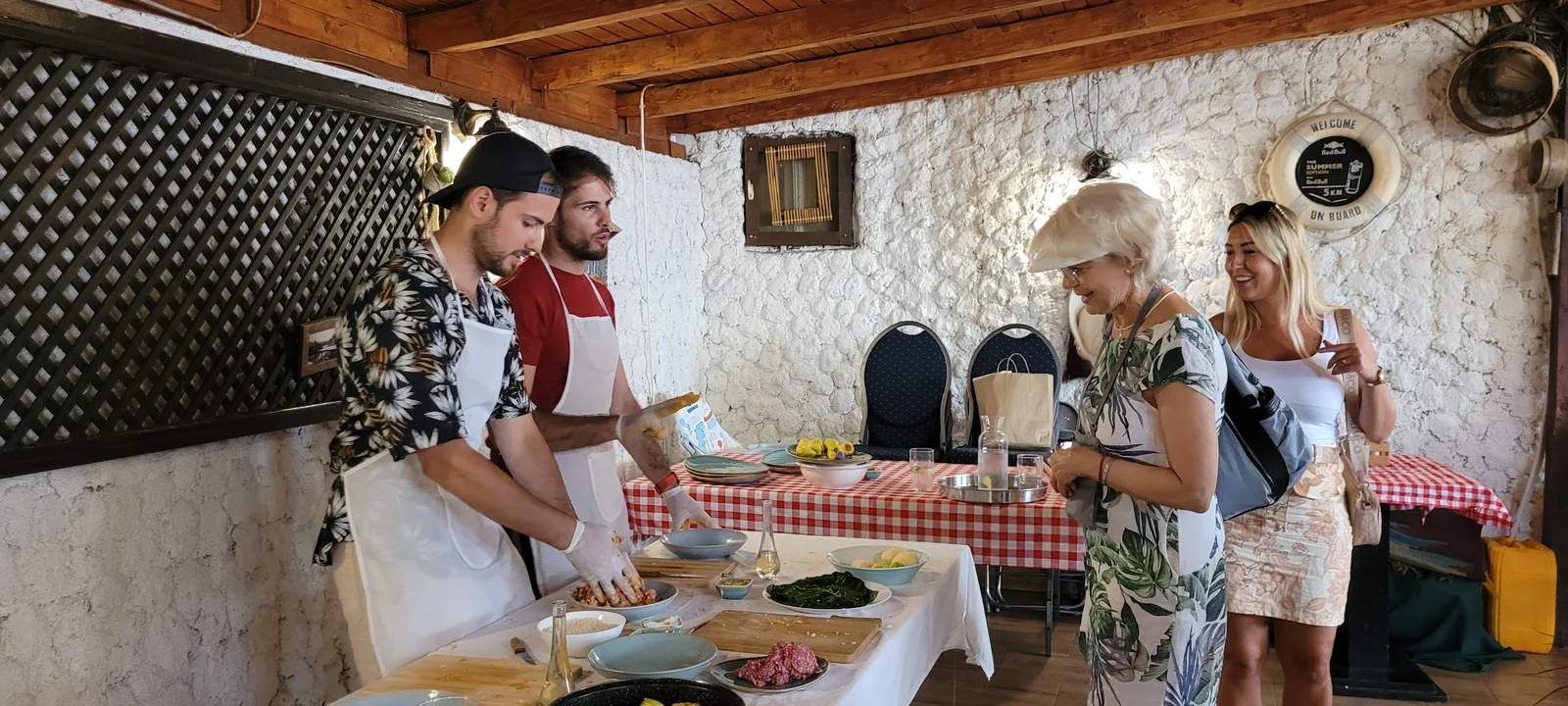
For a full Herzegovina-food + wine pairing day, our Bosnian cooking class can be combined with an afternoon wine tasting — burek/japrak/dolma/hurmašice in the morning, wine pairing in the afternoon. WhatsApp +387 62 694 887 for the combined-day quote.
When to visit
| Season | Notes |
|---|---|
| April–early May ✅ | Quiet, full availability, vines budding |
| May–June ✅ | Sweet spot — flowering vines, warm but not hot, lunch outdoors |
| July–August | Hottest, vines dormant-looking, tastings shift indoors |
| September ✅ | Vintage / harvest — peak experience, open-cellar events |
| Early October ✅ | Other peak window, autumn vine colours |
| November–March | Many smaller wineries close to walk-ins; book ahead |
Vintage Festival in Čitluk (mid-September) is the biggest local wine event — book accommodation 1+ month ahead.
How to do a wine day from Mostar
Standard guided package (€110–130/person, 6 hours):
- 09:30 Mostar pickup
- 10:00 Winery 1 — vineyard walk + 4-wine tasting
- 12:00 Winery 2 — cellar tour + 5-wine tasting + small plate
- 14:00 Winery 3 — full lunch with wine pairing (5–6 wines)
- 16:00 Drive back to Mostar
- 17:00 Hotel drop-off
For more granular routing or specific producer requests (Brkić-only, Trebinje day, Trnjak revival focus), our private transfers from Mostar can custom-route at €60+/vehicle for short routes. WhatsApp +387 62 694 887.
What to take home
For most travellers, the recommended set:
- 1 Žilavka Reserve (Brkić or Carski, €18–22)
- 1 Blatina (Brkić or Andrija, €15–20)
- 1 surprise: Trnjak from Andrija (€20–25) for the rare-grape angle, or Bena (white) if available
Customs: most countries allow 1L duty-free wine import; check your home rules. EU-to-EU is unlimited within reason. Most wineries provide bubble-wrap and offer to pack bottles in cardboard.
Shipping: limited — most small wineries don’t ship internationally. Ask for the contact of a Belgrade or Zagreb-based wine importer if you want larger quantities later.
Common mistakes
- Driving yourself wine-tasting — BiH BAC limit is strict (0.03%, lower than US/UK); use a tour or transfer.
- Visiting 5+ wineries in one day — tasting fatigue, palate exhaustion; 3 is the sweet spot.
- Walking in without booking — most small wineries don’t accept walk-ins.
- Skipping Žilavka because ‘I don’t drink white’ — Herzegovina Žilavka isn’t generic; it’s a distinct style worth trying.
- Buying only the cheapest tier — entry-level is fine but the interesting wines are €15+.
- Visiting July–August midday — vineyards dormant, tastings indoor; spring or autumn is far better.
- Confusing Herzegovina wine region with Trebinje wine region — different style focus (Žilavka-led vs Vranac-led).
Visit on a guided tour
For the standard 6-hour Herzegovina wine half-day from Mostar (3 wineries + winery lunch) at €110–130/person, our Herzegovina wine tour from Mostar product page has full itinerary, pickup logistics, and what’s included. WhatsApp +387 62 694 887 for booking + custom-pairing-day quotes.
For wine + Mostar Old Town + cooking class combined as a full Herzegovina food-and-wine day, our private transfers from Mostar can route the day end-to-end.
Related guides
- Herzegovina wine tour from Mostar — product page (when launched)
- Bosnian cooking class — pair with wine for full food-and-wine day
- Best restaurants in Mostar — for wine pairings on the drinks list
- Mostar travel guide — first-timer essentials
- Things to do in Mostar — combine wine tasting into your itinerary
- Pocitelj village guide — combine on the way to Čitluk wineries
- Stolac & Radimlja UNESCO — combine with a Stolac winery
FAQ
Frequently asked questions
What's special about Herzegovina wine?
Herzegovina has a **5,000+ year wine tradition** going back to Illyrian and Roman cultivation, but most international visitors haven't heard of it because Yugoslavia-era export quotas + 1990s war disruption kept the wines off Western markets until ~2010. The region has **two flagship indigenous grapes**: **Žilavka** (white) — crisp, mineral-driven, Mediterranean-warm but distinct from Croatian Pošip; **Blatina** (red) — full-bodied, dry, similar profile to Plavac Mali. **Karst soil** (limestone bedrock + thin red soil) and **400+ days of sunshine** annually give the wines their concentrated character. Top producers (Brkić, Carski, Nuić, Andrija) win Decanter awards regularly. The **Herzegovina Wine Route** connects 22 wineries across 6 municipalities.
What are the main grapes — Žilavka and Blatina?
**Žilavka** is the white grape — accounts for ~60% of Herzegovina production. Crisp acidity, mineral character from karst soil, citrus-and-stone-fruit aromatics, low residual sugar. Style is **dry to off-dry**, food-friendly, particularly pairs with grilled river trout (a Herzegovina classic). Best examples from **Brkić, Carski, Nuić, Andrija**. **Blatina** is the red grape — ~25% of production. Full-bodied, dry, dark-fruit-driven, similar profile to Croatia's Plavac Mali but with a slightly more austere structure from the karst terroir. **Vranac** (~10%) is also grown — bigger, more tannic. **Other indigenous**: Trnjak (red, near-extinct, recovering), Bena (white, near-extinct). Don't expect Burgundy — expect Mediterranean-mineral wines with their own identity.
Where is the Herzegovina Wine Route?
The **22-winery route covers 6 municipalities** in the Mostar–Trebinje corridor: **Mostar / Čitluk / Ljubuški / Trebinje / Stolac / Široki Brijeg**. Most wineries cluster around **Mostar (8 wineries)** and **Čitluk (Međugorje area, 5 wineries)** — easiest day-trip-from-Mostar concentrations. **Trebinje** has a strong cluster but is 90 min south. **Wineries are mostly small family operations** (3,000–50,000 bottles/year), open by appointment for tastings. **Few accept walk-ins** outside summer peak — book ahead via tour operator or direct contact. **Driving distances**: Mostar ↔ Čitluk 25 min, Mostar ↔ Trebinje 90 min, Mostar ↔ Stolac 45 min.
Which are the top Herzegovina wineries?
**Brkić** (Čitluk) — Decanter-decorated, Žilavka and Blatina specialists, mid-size. **Carski** (Čitluk) — boutique premium, oak-aged Žilavka. **Nuić** (Ljubuški) — large-format quality, restaurant on premises. **Andrija** (Mostar area) — boutique, Trnjak revival. **Vukoje** (Trebinje) — long-established, Vranac specialist. **Tvrdoš Monastery** (Trebinje) — Orthodox monastery winery, 16th-century roots, monastery tour included. Smaller hidden gems: **Đuzinac, Vinarija Skegro, Anđelić, Begić**. **Don't try to visit all 22** — pick 3–4 and enjoy proper tastings. Most tour packages cover Brkić + Carski + Nuić as the standard 'best-of' route.
How much do winery tastings cost?
**Tasting fees**: €10–25 per person at the winery (5–7 wines, 1.5–2 hours, includes light snacks like cheese and prosciutto). **Premium tastings** (€30–50) include vineyard walk, cellar tour, food pairing. **Bottles to buy**: €8–25 retail at the winery (most wines €10–15), so a couple typically takes home 3–5 bottles for €40–80. **Half-day guided wine tours** (transport included): €70–130/person depending on operator and number of wineries (3 wineries with lunch is the standard package). **Multi-day Wine Route packages**: €200–500/person across 2–3 days with accommodation. **Most wineries don't accept walk-ins** — book via tour operator or call ahead.
How do I do a winery visit from Mostar without a car?
**Best option: book a guided wine tour with transport included.** Solo wineries don't run shuttles, the wineries are spread across rural roads, and tasting wine + driving don't combine. **Standard package**: 6-hour half-day with 3 wineries (Žilavka + Blatina + Vranac), winery lunch at one estate, all transport from Mostar, English guide explaining grape varieties and terroir. €110–130/person, max 6–8 guests. Alternative: private transfer from Mostar to a single winery (€60–80/vehicle) for a 3-hour visit, then return — works for couples wanting one quiet winery experience. **Don't try the buses**: the wine villages are off public-transport routes.
What food pairs with Herzegovina wines?
**Žilavka pairs**: grilled river trout (the classic — Buna and Trebizat trout), salty cheeses (Travnički, Livanjski), olive oil-cured vegetables, light Mediterranean dishes, sushi (genuinely — the mineral acidity works). **Blatina pairs**: grilled lamb (Hercegovački janjac), aged hard cheeses, traditional Bosnian stews (bosanski lonac), wild boar, dark chocolate. **Most winery-lunch packages** serve a Herzegovina platter: prosciutto + cheese + olives + bread + dolma + the winery's own grilled-meat specialty, paired with 4–5 wines from their range. **Cooking class option**: combine wine tasting with our **[Bosnian cooking class](/bosnian-cooking-lessons/)** for a full Herzegovina-food day — burek/japrak/dolma/hurmašice paired with a wine flight.
What's the best time of year for wine tasting?
**May–June** for grape-flowering and lush vineyards; warm enough for outdoor lunch but not too hot. **September–early October** is the absolute peak — **vintage / harvest season**, 'open-cellar' events at many wineries, mature vintages still pouring, beautiful golden-vine landscape. **April + late October** are quieter shoulders with full availability and reduced prices. **July–August** works but vineyards are dormant and dry; tastings shift indoors due to heat. **Winter (Nov–Mar)**: many smaller wineries close to walk-ins; book ahead. **The Vintage Festival** in Čitluk (mid-September) is the biggest local wine event — book accommodation 1+ month ahead.
Which wines should I take home?
**For most travellers**: 1 Žilavka (Brkić or Carski reserve, €15–20) + 1 Blatina (Brkić, Vukoje, or Andrija, €15–20) + 1 surprise (Trnjak or Bena from Andrija for the rare-grape angle). **Don't buy the cheapest tier** — Herzegovina entry-level is fine but the producers you'll have heard of make the genuinely interesting bottles in the €15+ range. **Customs / luggage**: most countries allow 1L of duty-free wine import; check your home rules. **Carrying**: most wineries provide bubble-wrap and offer to pack; bring a wine sleeve for hand-luggage if flying. **Shipping**: limited — most small wineries don't ship internationally; ask for a Belgrade or Zagreb-based wine importer's contact if you want larger quantities later.
Should I visit Herzegovina wineries or Trebinje wineries?
**Different regions, different character.** **Herzegovina (Mostar area)**: more Žilavka focus, modernist new-generation wineries, easier to combine with Mostar Old Town visit. **Trebinje (90 min south of Mostar)**: more Vranac and Trnjak, traditional family wineries, picturesque hilltop villages, the historic Tvrdoš Monastery winery. **Recommendation**: if you have one day from Mostar, do **Čitluk wineries (25 min away)** — Brkić, Carski, Nuić, all close together. If you have 2–3 days, add **Trebinje (Vukoje, Tvrdoš)** as a separate day. **Most wine-tour packages from Mostar** focus on the Čitluk cluster because of distance economics.
What else can I combine with a wine tour?
**Standard combinations**: **Wine + Mostar Old Town** (morning wine, afternoon city walk) — the classic 1-day combo. **Wine + Medjugorje** (Čitluk wineries are 5–10 min from Medjugorje) — useful for groups with a religious member. **Wine + Kravica** (wineries 30 min from Kravica gate) — wine morning + waterfall afternoon swim. **Wine + cooking class** — full Herzegovina-food day with burek/japrak in the morning and wine pairing in the afternoon. **Wine + olive oil tasting** at a Stolac olive estate — for the full Mediterranean food-and-wine angle. Our **[private transfers](/private-transfers/)** can custom-route any of these — WhatsApp **[+387 62 694 887](https://wa.me/38762694887)**.
What are the most common wine-tour mistakes?
(1) **Trying to drive yourself wine-tasting** — drink-driving rules in BiH are strict (0.03% BAC limit, much lower than US/UK); use a tour or transfer. (2) **Visiting too many wineries in one day** — 3 wineries is the sweet spot; 5+ becomes a blur. (3) **Showing up without a booking** — most small wineries don't accept walk-ins. (4) **Skipping Žilavka because 'I don't drink white wine'** — Herzegovina Žilavka isn't generic European white; it's a distinct mineral-driven style worth trying. (5) **Buying the cheapest tier** — entry-level Herzegovina is fine but the genuinely interesting wines are in the €15+ range. (6) **Visiting in mid-July/August midday** — wineries shift to indoor tastings, vineyards are dormant; spring or autumn is far better. (7) **Not learning two phrases** — 'Žilavka' (ZHEE-lav-ka) and 'Blatina' (BLAH-tee-na) — the wineries appreciate the effort.