Mostar Attractions · 8 min read
Mostar Bridge Diving — Stari Most Divers Guide
Watch the divers jump from Stari Most. History since 1664, when they jump, tipping protocol, Red Bull Cliff Diving event, best photo spots.
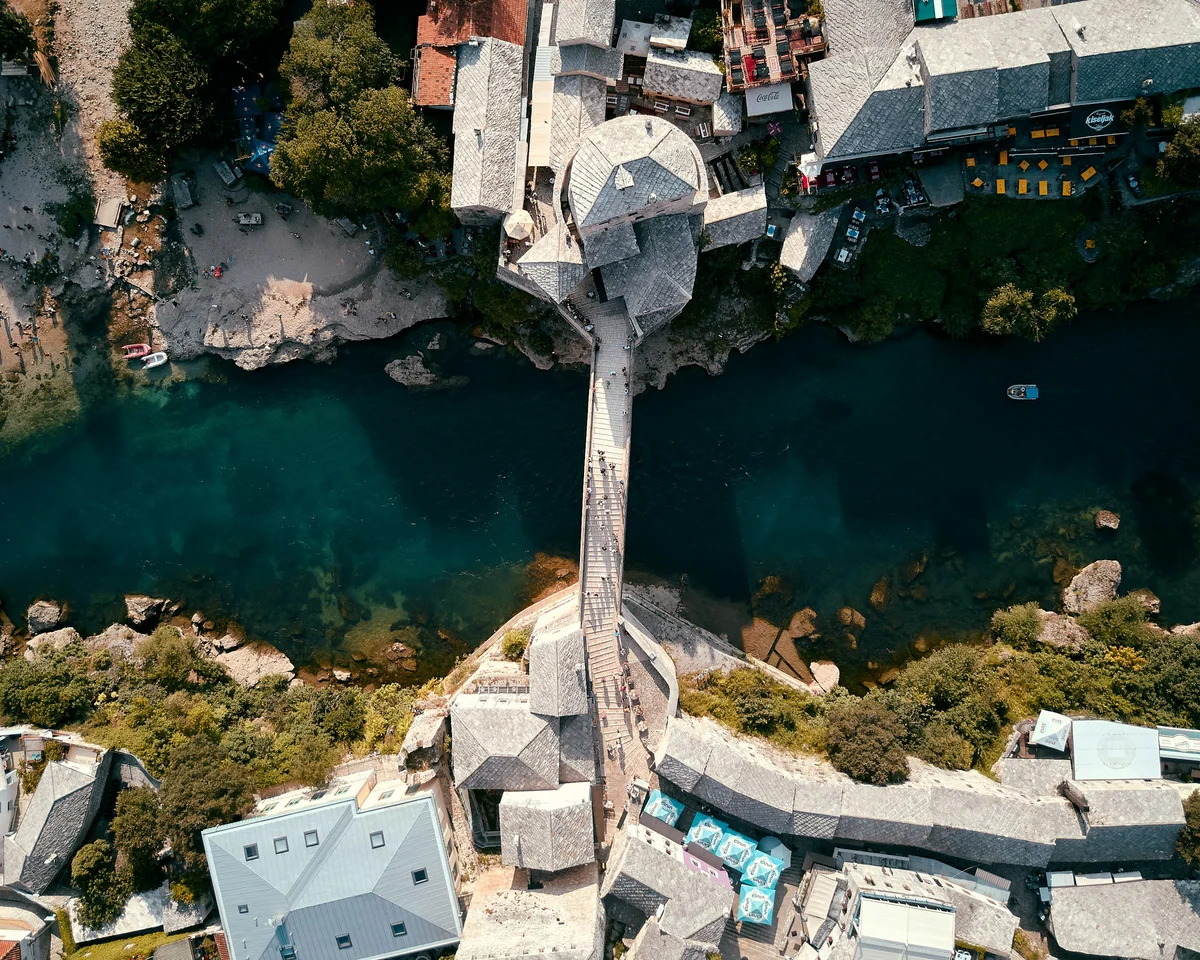
Quick answer
Watch the divers jump from Stari Most. History since 1664, when they jump, tipping protocol, Red Bull Cliff Diving event, best photo spots.
Quick answer: Mostar Divers Club members jump from Stari Most year-round, with most activity 11:00–15:00 from May–October. Each diver collects roughly €20–40 in tips before each jump; spectators contribute €2–5 per person. No tourist should ever attempt this — the 24-metre drop, 10–14°C water, and narrow safe-entry window have killed untrained jumpers. Best photo spot: the eastern riverbank downstream, not the bridge itself. The annual Red Bull Cliff Diving event lands in Mostar each late August / early September.
Stari Most is one of the few bridges in the world where the act of jumping off it is part of the cultural identity. People have been doing it since 1664, and they still do it today — for tradition, for tourist tips, and once a year for the Red Bull Cliff Diving World Series.
This guide covers everything: history, when divers jump, tipping protocol, the Red Bull event, and how to watch (and photograph) them properly.
A 360-year tradition
Stari Most was built in 1566 by Ottoman architect Mimar Hayruddin. The first recorded jump dates to 1664. Young men from Mostar — and only men, traditionally — would jump as a rite of passage, a test of courage before marriage.
The drop is 24 meters to the Neretva River below. The water is cold (12–17°C even in summer) because the Neretva is fed by mountain springs. The current is strong. The technique is to enter feet-first (called the “lasta” — swallow dive) to minimize injury.
Bad jumps mean broken bones, ruptured organs, or worse. People have died trying. No tourist should ever attempt this.
The Mostar Divers Club (Mostarski Skakači)
Founded informally generations ago, today’s divers are organized as the Mostar Divers Club. About 30 active members. To become one, you train under existing divers for 1–3 years before your first solo jump from the bridge.
The club has done over 50,000 collective jumps from Stari Most across all members. They’ve performed in shows worldwide. Many are also lifeguards along the Neretva — they’re the people who pull tourists out when they swim too far.
When divers jump
There’s no fixed schedule, but here’s what’s typical in tourist season (May–October):
- First jumps of the day: around 11:00 (after the morning chill burns off)
- Most active hours: 12:00–15:00 (peak tourist crowds)
- Evening jumps: sometimes 18:00–19:00 (golden hour, fewer crowds)
- Off-season (November–April): rare, only on warm days
Each jump is preceded by a tip collection. A diver walks the bridge with a bucket asking visitors to contribute. They need to collect roughly €25–40 (50–80 KM) before they jump.
Once enough is collected, they ring a bell or wave. Crowds gather along both riverbanks. The diver climbs onto the parapet, takes a few minutes to focus, and goes.
The whole sequence — collection to splash — usually takes 10–20 minutes.
Tipping protocol
If you watch a jump, tip. Not because the divers are entitled to it, but because tipping is what funds the tradition. Without tips, jumps don’t happen and the cultural practice dies.
- €2–5 per person is the going rate
- Tip in cash (KM or EUR)
- Tip BEFORE the jump (into the bucket), not after
- If you photograph or video the dive, definitely tip
If you don’t tip and just watch from the riverbank, that’s fine too — many tourists do — but the divers see you, and many of them know that the Western tourists who don’t tip outnumber those who do. It’s part of why the tradition is fragile.
Red Bull Cliff Diving Mostar
Since 2015, Mostar has hosted a stop on the Red Bull Cliff Diving World Series. Pro divers from around the world compete by jumping from a platform built on top of the bridge — adding about 3 meters to the natural bridge height (so 27 meters total).
- Date: late August or early September (varies year to year)
- Tickets: from €15 for general admission, €40+ for premium spots
- Crowds: 25,000–40,000 people pack into Old Town
- Accommodation: book 6+ months ahead. Prices triple
The event is shown on Red Bull TV and broadcast in 60+ countries. It’s the moment Mostar gets the world’s attention each year.
If you’re planning a Mostar trip during the event, double-check: it’s spectacular but the city is mobbed.
Best spots to photograph
Most tourists try to photograph from the bridge itself — which means they only see the diver’s back. Better positions:
Eastern riverbank (downstream of the bridge)
Best for: classic shot of diver against bridge backdrop. Walk down the steps to the riverbank near the Old Mosque, find a clear sight line.
Western riverbank (Crooked Bridge area)
Best for: wide-angle shots showing the bridge, the divers, and the cliff dives. About a 5-minute walk from Stari Most.
From a boat
If you’re on a Neretva boat tour, you can sometimes catch jumps from below. Different angle, lower viewpoint.
Avoid: the bridge top
You’ll see backs and the splash zone, not the actual dive trajectory.
Camera settings tips
- Shutter speed: 1/1000 or faster to freeze the splash
- Burst mode on — divers go fast, you’ll only have 1.5 seconds
- Pre-focus on the splash zone (water surface), not the bridge top
- For phone photographers: enable burst, hold the shutter for the full sequence
Combine with our walking tour
Our Mostar Walking Tour (€25, 2 hours) starts at 10 AM, which means we typically arrive at Stari Most around 11 — right when divers start their day. Armel often catches a dive during the tour and shares the history live.
If you specifically want to see divers, time your visit between 12:00 and 15:00 in the May–October season. We can plan a private walking tour around it — WhatsApp us at +387 62 694 887.
Visit on a guided tour
Our Kravica Waterfall day tour from Mostar combines the best of the Mostar region — Kravica Waterfall, Pocitelj fortress, and Blagaj Tekija — in one full day. €50 per person, hotel pickup, English-speaking guide, all entries.
For custom multi-stop trips with full flexibility, private transfers from Mostar start at €60/vehicle for short routes. WhatsApp +387 62 694 887.
Related reading
- Mostar Old Bridge — History Guide — the bridge’s 1566 origin, 1993 destruction, 2004 rebuild
- Things to Do in Mostar — 18 things beyond the bridge
- Mostar Photography Spots — the best vantage points across the city
FAQ
Frequently asked questions
Can a tourist jump from Stari Most?
**No, never.** Only certified members of the Mostar Divers Club (Mostarski Skakači) jump. The bridge is 24 metres above the Neretva — water that's 10–14°C even in summer, with strong currents and a narrow safe-entry window. Every untrained jumper has been killed, paralysed, or seriously injured — there are no exceptions. Tourists routinely ask if they can pay for a 'lesson and jump' — the answer from every diver is no, and the technique requires 1–3 years of training before a first solo jump. Watch, photograph, tip, and stay on the bridge.
How much should I tip the bridge divers?
Each diver collects roughly **€20–40 (40–80 KM)** in their bucket before they'll jump — that's the working minimum. As a spectator, **€2–5 per person** is standard. Tip in cash (KM or EUR both fine), put it in the bucket BEFORE the jump (not after), and tip especially if you photograph or video the dive. Tipping is what funds the tradition — without enough in the bucket, jumps don't happen, and many divers know Western tourists watch and walk away. €5 from a couple is generous, €10 from a group of 4 is appreciated.
When do the divers usually jump?
**Peak season (May–October), with most activity 11:00–15:00.** First jumps of the day are around 11:00 once the morning chill burns off; most active hours are 12:00–15:00 during peak tourist crowds; occasional evening jumps 18:00–19:00 in golden hour. **Off-season (November–April)** is rare — only on warm days and only if a group of paying spectators is gathered. Each jump cycle (collection → splash) takes 10–20 minutes; you can usually catch 2–3 jumps in an hour during peak times.
When is the Red Bull Cliff Diving Mostar event?
Annually since 2015, usually **late August or early September** (date varies year to year — check redbull.com/cliff-diving). It's an official stop on the Red Bull Cliff Diving World Series. Pro divers jump from a platform built on top of Stari Most, adding about 3 metres to the natural bridge height (27 metres total). **Tickets**: from €15 for general admission, €40+ for premium spots. **Crowds**: 25,000–40,000 people pack into the Old Town. **Accommodation**: book 6+ months ahead, prices triple, the entire bridge area becomes one giant pedestrian event zone for 36 hours.
Where's the best spot to photograph the divers?
**Eastern riverbank, slightly downstream** of the bridge — walk down the steps near the Old Mosque to the rocky river edge. Gives you the diver against the bridge as backdrop. **Western riverbank** near the Crooked Bridge approach, for wide-angle shots that include the bridge, the cliff face, and the diver mid-air. **From a boat**: a different lower viewpoint, sometimes catches the dive's underwater splash trail. **Avoid the bridge itself** — you'll only see the diver's back and the splash, not the trajectory or the bridge in frame.
What camera settings do I need?
**Shutter speed 1/1000s or faster** to freeze splash droplets cleanly; slower than 1/500s gets motion blur in the diver's body. **Burst/continuous mode ON** — the dive itself takes ~1.5 seconds and you'll get one chance. **Pre-focus on the splash zone** (the water surface where the diver enters), not the bridge top — autofocus often fails to track a falling body fast enough. **Phone photographers**: enable burst (hold the shutter button), and shoot from a wide-angle lens setting if your phone has multiple — easier to keep the diver in frame on a fast pan. Settings sample: ISO 200, shutter 1/2000s, aperture priority around f/4–f/5.6.
What's the history of bridge jumping in Mostar?
The first recorded jump dates to **1664 — almost 100 years after the bridge was built (1566)**. It started as a male rite of passage: young men would jump as a test of courage before marriage, with elders watching from the riverbank to confirm the technique. The tradition continued unbroken until the original bridge was destroyed in November 1993 during the war. After the bridge was rebuilt in 2004, the divers' club resumed jumps within weeks. Today's club has done over 50,000 collective jumps. The technique is to enter feet-first (the *lasta* — swallow dive) to minimise injury; bad jumps still mean broken bones or worse.
Are the divers safe? Has anyone died?
**Trained Mostar Divers Club members are safe** because of decades of accumulated technique knowledge — they know exactly when the river current is right, what water level is safe, where to enter, when to abort. Untrained jumpers (almost always tourists who ignore the warning) have been killed or paralysed. The club tracks injuries: most active members have at least one minor injury (compression fractures, rotator-cuff tears) over a long career. The water is colder than it looks (10–14°C even mid-summer because the Neretva is spring-fed); cold-water shock is a real risk, which is one reason untrained tourists fail.
Where are the divers from? Are they paid by the city?
Almost all are Mostar locals — many born within a few streets of the bridge. **They're not paid by the city, the tourism board, or any company.** Tipping is their entire income from bridge dives. Some moonlight as professional cliff-divers (Red Bull and similar), some work as Neretva lifeguards, some have other day jobs. The Mostar Divers Club is an informal cultural association, not a commercial operation. About 30 active members at any given time. Becoming one requires 1–3 years of training under existing divers before your first solo jump from the bridge — there's no shortcut.
Can I see the divers from the bridge restaurants?
Yes — the directly-on-the-bridge restaurants (the ones charging the 30–40% view tax — see [best restaurants in Mostar](/best-restaurants-mostar/)) have the closest seats to the action, but the camera angle is poor and you can't really see the dive trajectory. The riverbank restaurants below the bridge have better angles. **Cafe terrace at Hotel Bristol or other east-bank restaurants 30 metres back** gives a wider frame. If photography is your goal, eat first then move to the riverbank for the actual dive viewing — it's worth walking 50 metres to a better angle.
What other photo subjects are nearby?
While you're set up by the bridge, the same hour gives you several other shots: **the bridge lit at golden hour** from the Crooked Bridge approach (5 min walk upstream); **the Koski Mehmed-Pasha minaret view** of the bridge from above (€2 entry, narrow stairs); **the Old Bazaar coppersmiths working** at the open shop fronts east of the bridge; **the night-lit bridge from the riverbank steps** after sunset. See **[Mostar photography spots](/mostar-photography-spots/)** for the full list of vantage points across the city.
What are the most common mistakes spectators make?
(1) **Standing on the bridge to watch** — you only see backs and splashes; walk down to the riverbank for proper viewing angles. (2) **Not tipping** — many tourists watch the entire spectacle and walk away; the divers see this, and the tradition gets fragile. (3) **Coming at the wrong hour** — most jumps happen 11:00–15:00 in peak season; off-hours visits often see no jumps. (4) **Phone-shooting at single-shot mode** — you'll miss the dive almost certainly; switch to burst. (5) **Visiting during Red Bull week without a booking** — accommodation is 3x normal price and sold out 6 months ahead. (6) **Trying to climb the parapet for a 'photo'** — staff will stop you, locals will stop you, and the bridge surface is slippery polished cobble.